
MURPHY BEDS & WALL BEDS
Custom Murphy Beds & Wall Beds
A Murphy bed — or wall bed — folds up into a cabinet so a room can be an office, a den or a playroom by day and a proper bedroom by night. Dream Spaces designs, builds and installs custom Murphy beds across Barrie, the GTA and southern Ontario, built into cabinetry that matches the rest of the room instead of sitting against it.
What Is a Murphy Bed?
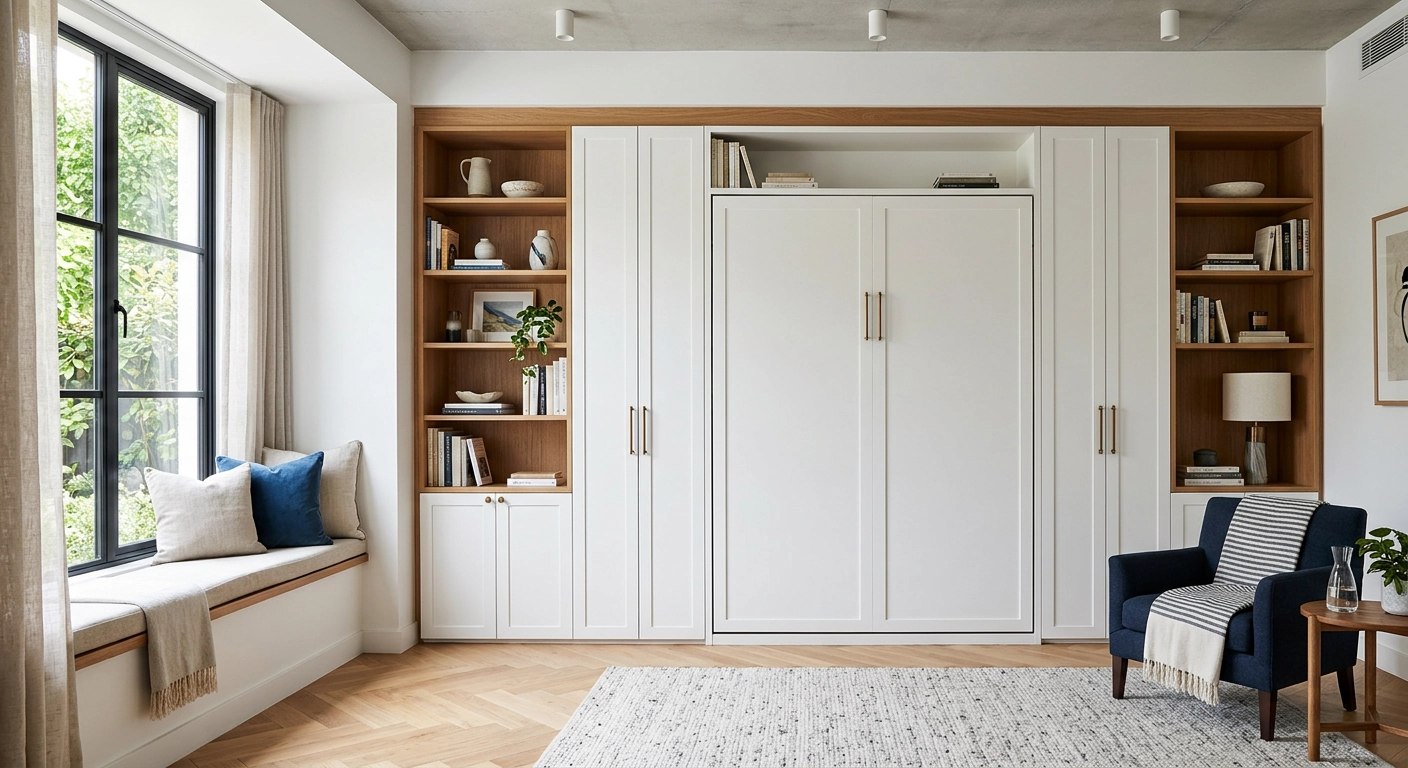
A Murphy bed is a bed that folds vertically into a cabinet against the wall. Closed, it reads as a run of cabinetry. Open, it’s a full bed with a real mattress on it. The name comes from William Murphy, who patented the idea in the early 1900s; wall bed is the same product under a plainer name, and you’ll see both used interchangeably.
The reason people buy one is almost never the bed itself. It’s the floor. A queen bed occupies roughly 30 square feet of a room permanently, whether anyone is sleeping in it or not. In a spare room that doubles as an office, a gym or a nursery, that’s the single biggest constraint in the space — and folding it away is the only way to get it back.
How a Murphy Bed Actually Works
Three things do the work, and they’re worth understanding before you shop.
The frame is anchored. The bed pivots on a hinged steel frame fixed to the wall studs, the floor, or both. That anchoring is non-negotiable — it’s what stops the cabinet tipping forward as the bed swings down.
The lift mechanism carries the weight. Gas pistons or tensioned springs counterbalance the bed and mattress so it comes down under control and goes back up without a fight. Correctly set, one person raises a queen with one hand. A mechanism tuned for the wrong mattress weight is the most common complaint people have about wall beds, which is why the mattress spec matters at design time and not after.
The mattress stays put. A retaining strap holds the mattress and bedding against the frame, so the bed is made once and folds away made. There’s nothing to store and nothing to set up.
Four Ways to Build a Murphy Bed
The bed mechanism is the easy part. What the rest of the wall does is the actual design decision, and it’s the one that determines whether the room works the other 350 days a year.
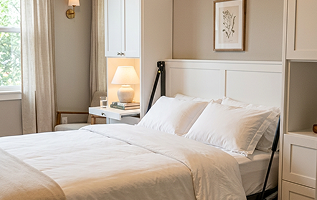
Classic Murphy bed. The bed and its cabinet, nothing else. The cleanest option when the room already has storage and you only need the floor back — a guest room, a finished basement, a rental suite.
Murphy bed with a desk. A full workspace by day that becomes a bed at night, with the desk surface designed so your monitor, lamp and papers stay put as the bed comes down over them. This is the configuration people ask about most.
Murphy bed with a sofa. The bed folds down over a sofa that stays exactly where it is. Turns a living room, den or condo into a guest room without giving up the seating.
Wall bed with storage. The bed sits inside a full cabinetry wall — wardrobe towers, drawers, bookshelves, overhead cupboards. The most storage you can get out of one wall, and the option that most often replaces a closet the room never had.
Murphy Bed Sizes: Twin, Double and Queen
Queen is the most-requested size, and the one most guest rooms are planned around. Double (full) saves roughly a foot of wall width and suits narrower rooms and condos. Twin works for kids’ rooms, bunk configurations and tight secondary spaces. King can be done, but the cabinet gets wide enough that it usually eats the storage you were trying to gain — we’ll tell you if that’s the trade you’re making.
Two measurements decide which size a room can take: the clear wall width, and the floor depth in front of it for the bed to swing into. A vertical queen needs a run of clear floor roughly the length of the bed, plus room to walk past it. If the room can’t give that up, a horizontal bed usually can.
Vertical or Horizontal?
A vertical Murphy bed folds down along its long edge — the standard arrangement, and the one that uses the least wall width.
A horizontal (sideways) wall bed folds down along its short edge. It’s wider and much shorter, which makes it the answer in two specific situations: rooms with low ceilings, and rooms where the only available wall is a wide one under a window or a slope. Basements and attic rooms are the usual candidates.
If you’re not sure which your room takes, that’s a measuring question rather than a shopping question — bring the room’s dimensions to a free consultation and a designer will tell you in about five minutes.
What Does a Custom Murphy Bed Cost?
There’s no useful single number, and any company that gives you one before seeing the wall is guessing. Four things move the price: the size of the bed, how much cabinetry surrounds it, the door and finish you choose, and whether the system includes a desk or a sofa mechanism. A bed-only cabinet and a full wall of wardrobe towers with a bed in the middle are very different projects.
What we can tell you at the consultation is the honest range for your room, and where the money actually goes. Our designs are quoted as built systems — design, build and installation by our own team, with Canadian-made materials and no subcontractors in the middle.
Murphy Beds Across Barrie, the GTA and Ontario
We design and install from our Barrie shop across Simcoe County, the Greater Toronto Area, York and Durham Regions, Halton, Waterloo Region and central Ontario. A designer comes to your home — measuring the wall in person is the only way to plan a wall bed properly.
A Murphy bed is usually one part of a bigger problem: a room that has to do two jobs. If that’s what you’re solving, our living spaces and multi-use rooms work and our custom closets tend to come into the same conversation, and the whole room can be planned as one system rather than three purchases.
FAQ
Murphy Bed Questions, Answered
What is a Murphy bed?
A Murphy bed is a bed that folds up into a cabinet against the wall when you’re not using it, freeing the floor the bed would otherwise occupy. It’s also called a wall bed — the two terms mean the same thing. The bed pivots on a hinged frame anchored to the wall or floor, and a lift mechanism carries most of the weight so one person can raise and lower it. The mattress stays on the bed, held by a retaining strap, so there’s nothing to store or make up each time.
Do Murphy beds need to be attached to the wall?
Yes. A wall bed is anchored — into wall framing, into the floor, or both, depending on the model and the room. That anchoring is what keeps the cabinet from tipping when the bed swings down, and it’s the main reason a wall bed is an installed piece of cabinetry rather than furniture you slide into place. Our own installers do the anchoring, so responsibility for it doesn’t get split between trades.
What sizes do Murphy beds come in?
Twin, double (full), and queen are the common sizes, and queen is the one most people ask for. King is possible but uncommon, because the cabinet gets wide enough that it usually costs you the storage you were trying to gain. Because we build to the room rather than to a stock cabinet, the surround is sized to your wall — not the other way around.
How much space does a Murphy bed take up when it's closed?
A vertical wall bed cabinet is typically around 16 to 18 inches deep when closed — roughly the depth of a bookcase. Add a sofa or a desk in front and the whole assembly gets deeper, which is why those configurations need to be planned against the room’s real dimensions rather than assumed. A designer measures the wall, the swing path, and the traffic route before anything is quoted.
Is a custom Murphy bed better than a ready-made one?
It depends on what you want from the wall. A ready-made unit is a fixed size in a fixed finish, and whatever gap is left between it and the wall stays a gap. A custom system is built to the opening, matched to the rest of your cabinetry, and can carry wardrobe storage, shelving, a desk, or a sofa in the same run. If the bed is the only thing you need and the size happens to fit, ready-made is a reasonable buy. If the wall has to do more than hold a bed, it usually doesn’t.
READY TO START?
Ready to Plan Your Murphy Bed?
Dream Spaces is a Canadian family-owned company run by Todd and Trish Clifford in Barrie, Ontario, with more than 10 years of custom cabinetry behind us. Our own team handles design, build, and installation from start to finish — never subcontractors — and every system we build is backed by our Homeowners Lifetime Warranty.
Ready to see what your room could do? Book a free design consultation or call 705-315-9169 — a designer comes to you. We design and install across Barrie, the GTA, and southern and central Ontario.
"*" indicates required fields